Systems fail. The people closest to them often know why and how.

We get their insights to you within a week.

Why some problems can be so complex
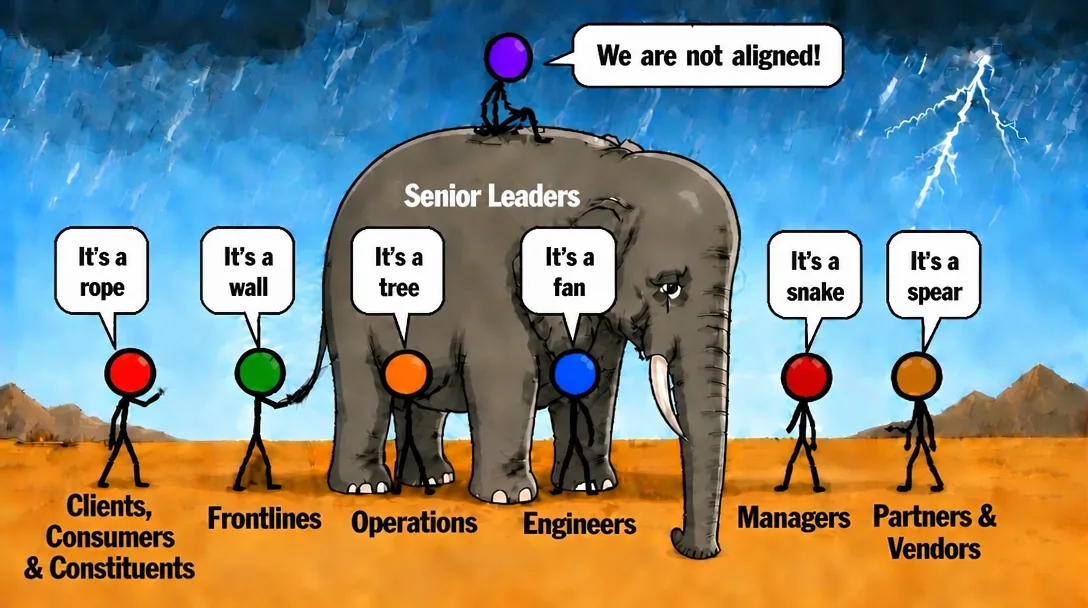
Illustration under a dark thunderstorm. Six stick-figure workers stand around an elephant, each touching a different part: 'It's a rope' (Clients, Consumers & Constituents), 'It's a wall' (Frontlines), 'It's a tree' (Operations), 'It's a fan' (Engineers), 'It's a snake' (Managers), 'It's a spear' (Partners & Vendors). A senior leader on top of the elephant says 'We are not aligned!'
Every role touching the problem has limited information. Performance indicators and budgetary lines can also nudge people to focus on one part of the larger problem.

What people.to.policy does

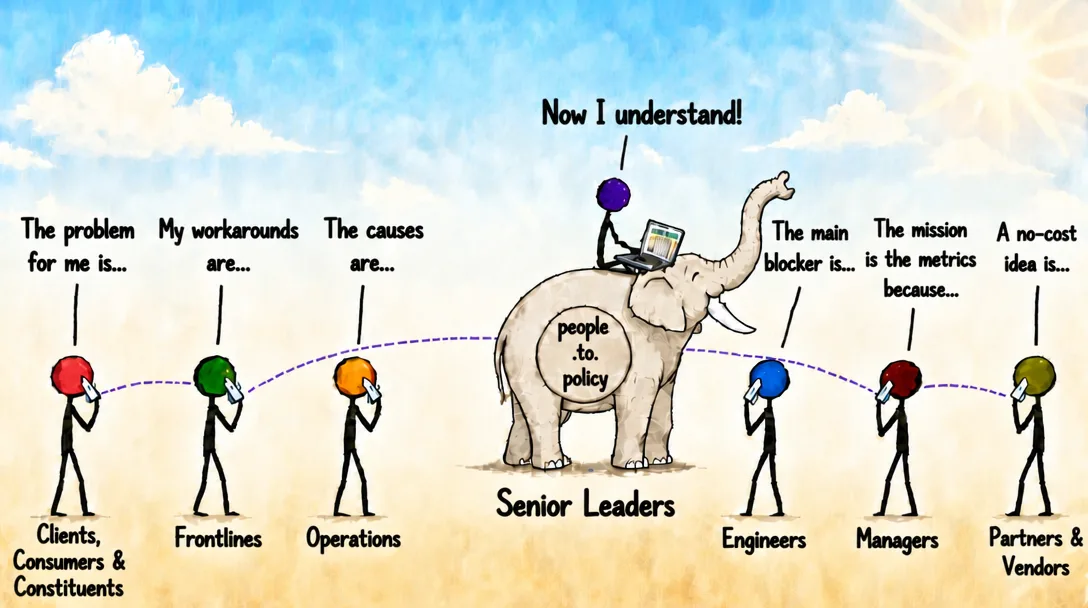
Illustration under a sunny sky. Six stick-figure workers each speak into a phone: 'The problem for me is...' (Clients, Consumers & Constituents), 'My workarounds are...' (Frontlines), 'The causes are...' (Operations), 'The main blocker is...' (Engineers), 'The mission is the metrics because...' (Managers), 'A no-cost idea is...' (Partners & Vendors). A senior leader sits on the elephant with a laptop saying 'Now I understand!' The elephant is marked with the people.to.policy logo and all six workers are connected by a dashed line.
Every role touching the problem calls us anytime for about 20 minutes. We ask the right questions, then deliver their insights to your inbox quickly.

Built for you

  • No special software to learn, your computer opens the spreadsheet
  • No consultant-speak, just plain language insights
  • No interview audio or transcripts retained past 30 days except where required by law
  • No caller data sold or shared and all data stays within the United States
  • No caller data trains AI models
  • No data integration required

How we pilot together

Step one

You name the biggest problem your organization is facing and every role who touches it. We listen and build around your needs.

Step two

We provide a dedicated phone number for your project. You share it with everyone touching the problem and ask them to call anytime for around 20 minutes. No scheduling.

Our interview questions have been refined over 10+ years removing systemic failures in governments.

Step three

Within a week you receive a spreadsheet that puts workarounds and low-cost improvement ideas first, with doable next steps. We review the findings and next steps together to confirm they are clear and doable.

Before we begin

We will ask how much you are comfortable with us sharing publicly from what we learn together.

This spreadsheet has three tabs: Summary, Blockers & Improvements and Next Steps. The middle tab, Blockers & Improvements, is open. Tab controls are at the bottom of this section.

Summary
# people called in: 23
8 frontline workers, 6 community partners, 5 policy analysts and 4 clients
# workarounds being used: 17
Example: A county frontline worker moved Friday renewals to Monday to test if the weekend gives clients more time. It helped and resulted in this worker saying their caseload renewals increased to 85% compared to the 71% office average they reported. They have been doing this for the past six weeks.
# improvement ideas: 31
Example: A community partner said they tracked the # of clients in the past three months who don’t complete their online renewal in one sitting and learned that 79% of them never completed it. The analyst said text and email reminders might help incomplete renewal clients.
Sample Blockers & Improvements tab with two rows. Each row lists the problem, who named it, how people are working around it and improvement ideas they shared.
1 Blockers & Improvements
2 Problem Who named it How people are working around it Improvement ideas people shared
3 Form errors on fields that never change (SSNs, DOBs, etc.), but clients fill out the same information every renewal cycle. Frontline Worker “I pre-filled anything that wouldn’t change before the client touched the form, like Social Security Numbers, birth date, etc. Errors dropped. I didn’t tell others, because they might feel I’m saying how to do their job.” Pre-filling static fields system-wide before clients access forms. One nonprofit already proved it works.
4 Completion rates looked good, but most cases got submitted Thursdays because workers learned the system reviews cases every Friday. Cases in by Thursday made the cut; later ones waited a week. Analyst “The system teaches workers when to submit, not how to review. I did not write it up because I did not know who it was safe to tell.” Running the batch process daily removes the Thursday pressure entirely. No retraining or policy change needed.
Sample Next Steps tab with two rows. Each row carries forward an idea worth testing. The project team fills in the editable if/then plan and selects priority and status.
1 Next Steps
2 Problem or workaround Improvement idea people shared If/then plan Priority(high, medium, low) Status(not started, in progress, done)
3 Many clients start their online renewal but don’t finish in one sitting. 79% never come back to complete it.
Community Partner
Send text and email reminders to clients with incomplete renewals. If [task owner] does [action] by [date], then we should expect [measurable outcome].
4 A county frontline worker moved Friday renewals to Monday to test if the weekend gives clients more time. It helped and resulted in this worker saying their caseload renewals increased to 85% compared to the 71% office average they reported. They have been doing this for the past six weeks.
Frontline Worker
Ask a unit of frontline employees to try this to test and learn what happens. If [task owner] does [action] by [date], then we should expect [measurable outcome].

Inside a call

Every response is confirmed.

Interview sample - 11 seconds
0:00 0:11

A clip of an automated interviewer and a member of people.to.policy. A call runs about 20 minutes.

Transcript
Automated Interviewer
Let me make sure I understand. You put together a binder with clearer, easier to understand information, and you make photocopies to hand out to the clients when they come into the lobby. Is that right?
people.to.policy team member
That’s right.

FAQs

Team

Marc Hébert Marc

CEO

A cultural anthropologist, Ph.D. who spent 10+ years in government from service design inside a county human services agency and a federal data team to protecting consumers for a regulator.

Nikko Patten Nikko

CTO

20+ years building successful products as a serial founder by designing the human systems that make great software possible. He leads agentic system development for a publicly traded company.

Curtis Mitchell Curtis

Lead Engineer

15 years in software, data and technical roles solving the gnarliest problems for startups, NASA, the Census Bureau and a state government. He ensures and maintains the security and privacy of applications to protect end users and customers.

The people touching your biggest problem may already be working around it.

Want to find out together?